Introduction: The End of the "Download to Join" Era
Think back to the last time you invited a new client or external partner to a virtual meeting. How much of the first five minutes was wasted on technical friction? Was someone forced to download an app update? Did they struggle to configure their microphone permissions within a bulky desktop client? Did a firewall block their installation?
As we move deeper into 2026, the tolerance for this kind of onboarding friction has plummeted. Businesses and educators no longer want to act as IT support just to get someone into a conference room. The solution—and the new industry standard—is the browser-based virtual meeting.
By eliminating third-party downloads and leveraging the native capabilities of modern web browsers, platforms like Hehllo are fundamentally changing how we connect. Here is why desktop video applications are rapidly becoming obsolete in favour of native web experiences.
The True Cost of Desktop Video Applications
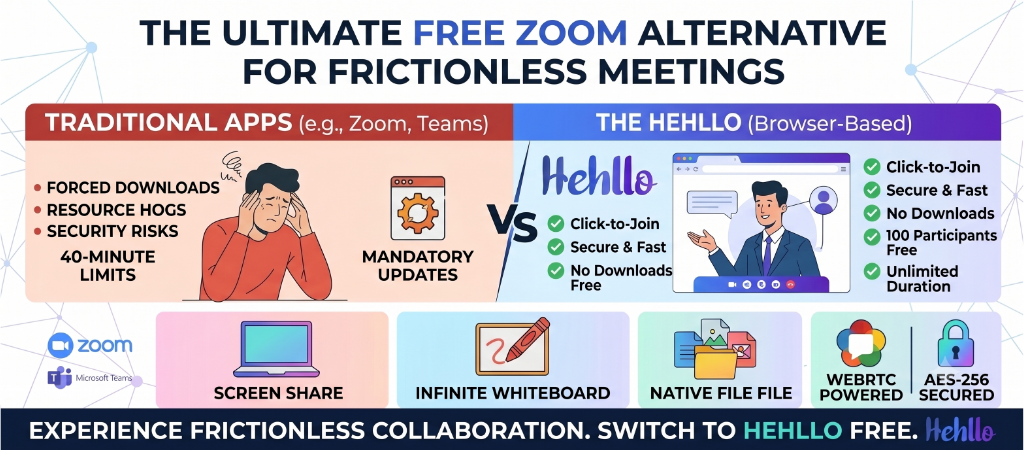
For years, dominant platforms operated on a "walled garden" model, requiring users to install proprietary software (like the Zoom or Microsoft Teams desktop apps) to access full features. While this initially allowed those companies to optimise performance, it created significant drawbacks for the end-user:
-
The Onboarding Barrier: Forcing an external guest to download software creates a terrible first impression. It adds stress to high-stakes sales calls and introduces unnecessary delays to urgent problem-solving sessions.
-
Resource Hogging: Desktop video apps are notorious for consuming massive amounts of RAM and CPU. This leads to overheating laptops, rapidly draining batteries, and frozen screens—especially when users try to multitask or run complex software alongside the call.
-
The Update Treadmill: Native applications require constant, mandatory updates. Finding out you are locked out of a meeting until a 300MB update finishes downloading is a uniquely frustrating, yet incredibly common, experience.
WebRTC: The Engine Behind Frictionless Meetings
The shift toward the browser-based virtual meeting is powered by a technology called WebRTC (Web Real-Time Communication). Originally introduced as an experimental project, WebRTC has matured into the robust, open-source backbone of the 2026 real-time internet.
WebRTC allows modern browsers (Chrome, Edge, Firefox, Safari) to communicate directly with each other via peer-to-peer connections. Platforms built entirely on this architecture, like Hehllo, do not require you to download a wrapper, an extension, or a plugin.
When you click a Hehllo meeting link, the browser handles the media capture (your camera and microphone), the encoding, and the transmission natively. The result is a truly frictionless experience: Click the link, and you are in.
The Benefits of a Native Web Architecture
-
Instant Access: Whether your guest is on a corporate desktop, a personal laptop, or a tablet, they can join instantly through their default browser.
-
Minimal System Impact: Because the browser is already optimised for handling media, platforms like Hehllo run incredibly light. You can share your screen, manipulate a complex spreadsheet, and run a 100-person video call simultaneously without crashing your machine.
-
Universal Compatibility: A browser-based virtual meeting platform works across all major operating systems (Windows, macOS, Linux, ChromeOS) without requiring different versions of an app.
Why Browser-Based Meetings Are Actually More Secure
There is a persistent myth that dedicated desktop applications are more secure than web browsers. In reality, regarding WebRTC video conferencing security, the browser sandbox offers significant protective advantages.
When you install a desktop application, you are granting that software extensive permissions to access your local file system, registry, and background processes. If that application has a vulnerability, your entire machine is at risk.
Here is how browser-based platforms like Hehllo prioritise security by default:
1. The Browser Sandbox
Browsers operate in a highly restricted "sandbox." Even if a malicious script were somehow executed during a web meeting, it is mathematically isolated from your computer's local operating system and private files.
2. Mandatory End-to-End Encryption
Security in WebRTC is not a premium feature you have to toggle on; it is baked into the foundation. Every WebRTC session requires mandatory end-to-end encryption using SRTP (Secure Real-time Transport Protocol) and DTLS (Datagram Transport Layer Security) for all media and data streams.
3. Granular Permission Controls
When you use a browser-based virtual meeting, you retain strict control over your hardware. The browser will explicitly ask for permission to access your camera and microphone for that specific session. Once the tab is closed, access is instantly revoked, ensuring no background apps are silently monitoring your hardware.
Bringing Complete Workspaces into the Browser
The ultimate advantage of a native web experience is integration. By stripping away the heavy desktop client, platforms like Hehllo can focus on rendering rich, collaborative tools directly alongside the video feed.
Because it utilises WebRTC DataChannels—which allow arbitrary data to pass between peers instantly—Hehllo can offer features that traditional apps struggle to synchronise:
-
Native File Rendering: Share a high-definition video or a 50-page PDF directly in the browser tab. The document renders locally for each user, meaning there is no blurry screen-sharing or stuttering frame rates.
-
Real-Time Whiteboarding: Because data passes peer-to-peer with sub-second latency, multiple users can sketch, write, and brainstorm on an infinite whiteboard simultaneously, with zero noticeable lag.
Conclusion: The Future is Frictionless
The friction of downloading, updating, and managing proprietary video software is no longer a necessary evil. As teams become more distributed and the demand for instant collaboration grows, the browser-based virtual meeting has emerged as the definitive solution.
With Hehllo, you can host up to 100 participants for free, with unlimited durations, using nothing but the browser you are already using. It is secure, it is lightning-fast, and most importantly, it gets the technology out of the way so you can focus on the conversation.
How does this look? For the next article, would you like to focus on the virtual workspace with whiteboard (collaboration and training), or the free video conferencing tool aspect (scaling to 100 users for free)?